
Platform integration, communication drivers and engineering tools connect shop-floor equipment with applications, supporting tag configuration, system development and operational messaging.
Ignition SCADA 平台
Ignition is a modular industrial application platform by Inductive Automation. Visualization, data acquisition, alarms and historical data can be organized around project needs. Module and client licensing scope must be checked against the actual configuration.

Platform Features:
- Visualization applications — browser access or desktop clients selected for the application
- Cross-platform — Windows / Linux support
- Modular design — load functional modules on demand, flexible expansion
- Redundant deployment — primary/standby design and verification based on project requirements
Core Modules:
- Perspective — Web-based HMI, responsive across PC / tablet / mobile
- Vision — Traditional desktop client, ideal for control room workstations
- Tag Engine — data modeling and live acquisition; scale and refresh strategy designed per project
- Alarm Engine — Multi-level alarm notification, pipeline processing
- Historian — SQL database storage, trend analysis
Certifications:
Huishuo is an Inductive Automation Certified System Integrator with 1 Gold and 4 Core certified engineers.
S7Plus-Driver 自研驱动
Huishuo’s in-house S7CommPlus protocol driver provides a complementary implementation path for equipment communication and platform integration. Connection and variable-access tests have been performed with a Siemens S7-1500 PLC in a specific environment. CPU model, firmware, software versions and supported features must be verified for each project.
- Native port 102 communication with TLS 1.3 encryption support
- Runs on Windows / Linux
- Validated at 30,921 tags in a specific test environment (see benchmark below)
Benchmark (existing results from a specific test environment):
Test conditions: Siemens S7-1500 PLC · 30,921 tags · LAN environment
| Item | Result | Notes |
|---|---|---|
| Connection setup | ~300 ms | — |
| Full tag browse | ~1.9 s | — |
| Full variable read | ~7 s | — |
| Average latency per variable | ~220 μs | Amortized mean derived from the full read; not an end-to-end refresh cycle |
| Cache-hit read P50 | 4 μs | Driver-side cache read latency; not PLC communication latency |
Boundary statement: the above are existing results from the specific environment described, not a performance guarantee. They do not represent other PLC models, CPU/firmware versions, tag counts, network conditions or security modes; actual results depend on hardware, network and operating conditions. Suitability for a specific project must be checked and verified against site conditions.
Selection checklist:
- Whether the site PLC supports S7CommPlus access (CPU model and firmware version to be verified item by item)
- Whether the project requires optimized blocks (DBs) to remain enabled
- Whether the network security policy requires encrypted communication (e.g. TLS) or disables PUT/GET
- Whether tag counts, browsing and refresh requirements match; a pilot test under real conditions is recommended
- Deployment platform (Windows / Linux) and host software version compatibility
PLC 扫点工具
Huishuo’s self-developed Siemens PLC engineering efficiency tool for one-click I/O point scanning, filtering, and exporting.
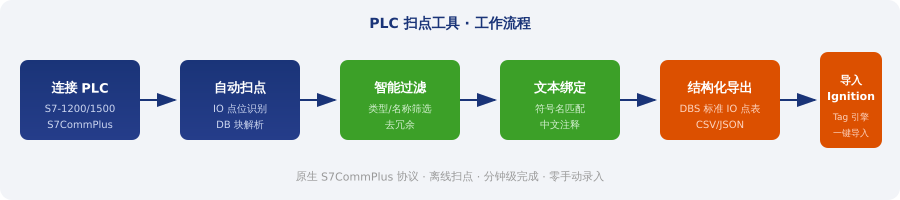
Core Functions:
- Auto Scan — identify accessible I/O, DB blocks and variable structures for Siemens S7-1200/1500 PLCs; model, firmware and access conditions must be verified per project
- Smart Filtering — Filter by data type, naming convention, address range to eliminate redundant and unused points
- Text Binding — Auto-match PLC symbol names with process descriptions, generate point lists with Chinese annotations
- Structured Export — Generate I/O point lists compliant with DBS PLC structure standards, clearly hierarchical and categorized
- One-Click Ignition Import — Exported point structures can be directly imported into Ignition Tag Engine — no manual creation
- Batch Operation — Multi-PLC concurrent scanning, suited to multi-controller, multi-station projects
Typical Scenarios:
For multi-PLC deployments such as paint and body shops, the tool helps reduce point-by-point configuration, repetitive data entry and change-maintenance work.
Technical Features:
-
Native S7CommPlus protocol — no OPC UA intermediary
-
Version comparison and incremental update — change tracking at a glance
-
Supported PLC models and firmware range must be verified per project
信息推送
Huishuo’s self-developed Ignition message push module enables seamless integration of production alarms and key events with mainstream instant messaging platforms such as Feishu and WeCom.
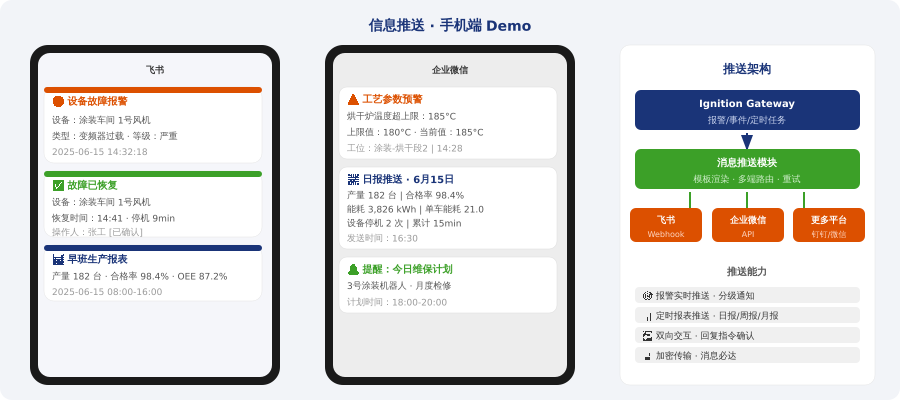
Core Functions:
- Multi-Platform Push — Supports Feishu, WeCom, DingTalk, WeChat and more; configure once, sync everywhere
- Real-Time Alarm Notification — Ignition alarm engine triggers auto-push to designated groups or individuals, including alarm level, device, timestamp, and full description
- Custom Message Templates — Supports Markdown / rich text / card messages, with embedded production data (output, takt time, OEE) rendered in real time
- Interaction Integration — message acknowledgments and status-query scope must be checked against platform interfaces, permissions and project security requirements; production-control commands are not enabled by default
- Scheduled Push — Auto-push production reports, energy summaries, equipment efficiency briefs by shift / day / week
- Event-Driven — Auto-trigger push based on Ignition Tag changes and Gateway events, no manual intervention required
Typical Scenarios:
- Equipment faults auto-push alarms to maintenance group with fault location and suggested resolution
- End-of-shift auto-push of output, quality rate, energy consumption reports to management group
- Critical process parameter exceedance triggers real-time alert to process engineers
- Major downtime events instantly notify management with escalation support
Technical Features:
- Native Ignition Gateway module — no additional middleware required
- Webhook / API integration; connectivity and proxy arrangements must meet the customer’s network policy
- Message content, transport and log retention must be reviewed against the project’s security policy
- Push status tracking with retry mechanism — improved delivery reliability